Strokal, V., & Kovpak, A.
(2022).
Anthropogenic impacts on water quality of Kyiv Reservoir (Part 2: Water quality and pollution sources).
Biological Systems: Theory and Innovation,
13(2),
46-66.
https://doi.org/10.31548/biologiya13(3-4).2022.073
Biological Systems: Theory and Innovation

Anthropogenic impacts on water quality of Kyiv Reservoir (Part 2: Water quality and pollution sources)
V. Strokal, A. KovpakAbstract
This article focuses on water quality and its pollution sources of Kyiv Reservoir. The findings reveal the main pathways of chemical elements to enter the water body (including biogenic elements). Data on the state of water according to indicators are given by year (20162021). Based on literature research, the reservoir has considerable concentrations of biogenic substances (nitrogen, phosphorus and others). This causes organic pollution. These substances can accumulate in the reservoir. Natural factors influencing this accumulation are temperature, wind direction, intensity of currents reservoirs. Anthropogenic factors are pollution sources such as agricultural and industrial enterprises, constructions on the banks of the reservoir, discharges of household waste from residential and communal enterprises. The most important anthropogenic sources are enterprises "Agromas", and "Chipsy Lux", hydroelectric power plants, unauthorized landfills that are the result of recreation, domestic waste from communal farms and the private sector, plowing of agricultural lands. Socio-economic factors also play a role. This includes the development of the population, the level of innovative technologies to treat wastewater, political conditions
Keywords
Kyiv Reservoir; hydrogeological conditions; pollution sources; anthropogenic load on rivers
Suggested citation
References
[1] A mobile device for measuring the radiation background. (n.d.). Retrieved from https://map.safecast.org/?y=50.52&x=31.65&z=8&l=0&m=0.
[2] About the results of the work of scientists of the Institute of Problems of Mathematical Machines and Systems of the National Academy of Sciences of Ukraine. (2022). Retrieved from https://www.nas.gov.ua/UA/Messages/Pages/View.aspx?MessageID=9011.
[3] AmeriGEO: Ukraine – subnational administrative boundaries. (n.d.). Retrieved from https://data.amerigeoss.org/it/dataset/ukraine-administrative-boundaries-as-of-q2-2017.
[4] Davydov, O.V., & Mokra, P.O. (n.d.). General features of the development of the coastal zone of the cascade of the Dnipro Reservoirs at the current stage.
Retrieved from http://ekhsuir.kspu.edu/bitstream/handle/123456789/8201/%D0%94%D0%90%D0%92%D0%98%D0%94%D0%9E%D0%92%20%D0%9E.%D0%92.%2C%20%D0%9C%D0%9E%D0%9A%D0%A0%D0%90%20%D0%9F.%D0%9E..pdf?sequence=1&isAllowed=y.
[5] Depth map of the Kyiv Reservoir. (n.d.). Retrieved from https://ua.fishermap.org/depth-map/kievskoe-vodohranilische/.
[6] Dnipro River basin: Map. (n.d.). Retrieved from http://www.karty.by/2011/10/11/basyn-dnepr/.
[7] DSanPiN2.2.4-171-10. (2010). Hygienic requirements for drinking water intended for human consumption. Retrievred from https://online.budstandart.com/ua/catalog/doc-page.html?id_doc=27272.
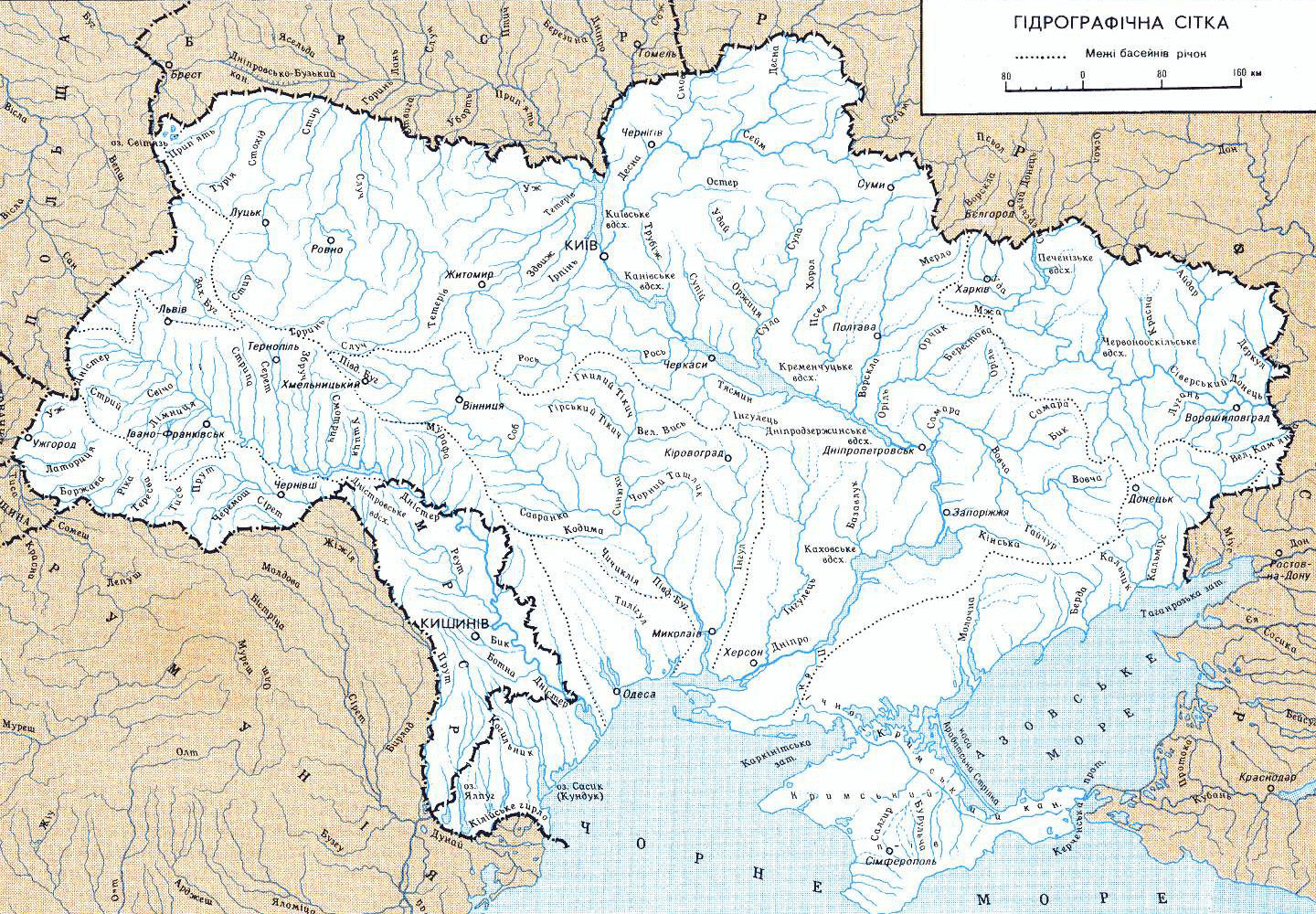
[8] Hydrographic grid of river basins of Ukraine. (n.d.). Retrieved from https://www.imbf.org/karty/images/detailed-rivers-map-of-ukraine-hq.jpg.
[9] Interactive map of river pollution in Ukraine based on data from the State Water Resources Agency of Ukraine. (n.d.). Retrieved from https://texty.org.ua/water/.
[10] Khilchevskyi, V.K. (2022). Vodni ta zbroini konflikty – klasyfikatsiini oznaky: Water and armed conflicts – classification features: In the world and in Ukraine. Hydrology, Hydrochemistry and Hydroecology, 1(63), 6-19. doi: 0.17721/2306-5680.2022.1.1.
[11] Khilchevskyi, V.K., & Hrebin, V.V. (2021). Large and small reservoirs of Ukraine: Regional and basin features of distribution. Hydrology, Hydrochemistry and Hydroecology: Bioresources and Water Ecology, 2(60), 6-17. doi: 10.17721/2306-5680.2021.2.1.
[12] Klochenko, P.D., & Shevchenko, T.F. (2019). Epiphyton as bioindicator of the state of the upper-cascade Dnipro Reservoirs. Hydrobiological Journal, 55(4), 26-37.
doi: 10.1615/HydrobJ.v55.i4.30.
[13] Klymenko, M.O., Vozniuk, N.M., & Verbetska, K.Yu. (2012). Scientific Reports of National University of Life and Environmental Sciences of Ukraine, 8(30).
Retrieved from https://nd.nubip.edu.ua/2012_1/12kmo.pdf.
[14] Kuzmenko, M.I., Hudkov, D.I., & Pankov, I.V. (2001). Radionuclides and their ecological significance in the reservoirs of Ukraine. Retrieved from http://dspace.tnpu.edu.ua/.
[15] Litvinenko, V., Kotovska, G., Buzevitch, O., & Khrystenko, D. (2021). Length-weight relationship and condition factors of white bream (Blicca bjoerkna (Linnaeus, 1758)) from the Kyiv Reservoir. Aquaculture, Aquarium, Conservation & Legislation, 14(6), 3283-3290. Retrieved from http://www.bioflux.com.ro/docs/2021.3283-3290.pdf.
[16] Lytvynenko, V.O., & Khrystenko, D.S. (2021). Peculiarities of using the Kyiv Reservoir as a fishery water object (overview). Fisheries Science in Ukraine: Bioresources and Water Ecology, 4(58), 5-28. doi: 10.15407/fsu2021.04.005.
[17] MapCruzin: Ukraine ArcGIS shapefile map layers. (n.d.). Retrieved from https://mapcruzin.com/.
[18] Mykhaylyk, O.O. (2021). The banks of the Dnipro River in Kyiv: development and transformation in time. Modern Technologies and Methods of Calculations in Construction, 16, 103-108. doi: 10.36910/6775-2410-6208-2021-6(16)-13.
[19] Nesterova, K.A., Kopilevych, V.A., & Lavryk, R.V. (2021). Assessment of the quality of water for irrigation. Riga: Baltija Publishing House.
[20] Shamanskyi, S.Y., & Boichenko, S.V. (2018). Standardization of maximum permissible discharges of biogenic elements into water bodies with wastewater in Ukraine. Environmental Sciences, №2(21), 119-126: Retrieved from http://ecoj.dea.kiev.ua/221-2018.
[21] Shcherbak, V.I. (2015). Phytoplankton succession of the Kyiv Reservoir and assessment of its transboundary section. Scientific Notes of the Ternopil National Pedagogical Institute: Biology, 3–4(64), 757-760. Retrieved from http://dspace.tnpu.edu.ua/bitstream/123456789/5946/1/Scherbak.pdf.
[22] Strokal, V. (2021). Transboundary rivers of Ukraine: Perspectives for sustainable development and clean water. Journal of Integrative Environmental Sciences, 18(1), 67-87. doi: 10.1080/1943815X.2021.1930058.
[23] Strokal, V., & Kovpak, A. (2021). Ecological assessment of water quality for different water uses: The upstream sub-basin of the Dnipro and Desna rivers. Biological systems: Theory and Innovations, 12(2), 24-40. doi: 10.31548/biologiya2021.02.003.
[24] Strokal, V., Makarenko, N., Chorna, T., & Kovpak, A. (2021). Ecological assessment of the toxicity of nitrogen compounds for aquatic organisms using the Lemna minor L. biotest. Scientific Reports of National University of Life and Environmental Sciences of Ukraine, 6(94). doi: 10.31548/dopovidi2021.06.002.
[25] Strokal, V.P., & Kovpak, A.V. (2021). Causes of nutrient pollution in the Dnieper river basin: theoretical syntheses. Environmental Sciences, 2(35), 37-44. doi: 10.32846/2306-9716/2021.eco.2-35.6.
[26] Timchenko, V.M., et al. (Ed.). (2013). Abiotic components of the Kyiv Reservoir ecosystem. Kyiv: Institute of Hydrobiology NAS of Ukraine.
[27] Voitenko, L.V., Strokal, V.P., & Myroniuk, O.O. (2018). Environmental assessment of local water resources on the example of the city of Kamianets-Podilskyi. Tavrian Scientific Herald, 1(100), 287-292. Retreived from
http://www.tnv-agro.ksauniv.ks.ua/archives/100_2018/part_1/43.pdf.
[28] Voitenko, L.V., Strokal, V.P., Myroniuk, O.O., Kochyn, K.O., & Voitenko, A.H. (2017). Methodology of comprehensive assessment of water quality for irrigation. In Materials III international scientific and practical conference of young scientists (62-78). Kyiv: Institute of Water Problems and Land Reclamation of NAAS.
[29] Volkova, E.N., Belyaev, V.V., Prishlyak, S.P., Parkhomenko, A.A., & Karapysh, V.A. (2012). Peculiarities of forming radioactive contamination of higher aquatic plants from Kyiv Reservoir. Nuclear Physics and Power Engineering, 160-165. Retrieved from https://inis.iaea.org/search/search.aspx?orig_q=RN:44117056.
[30] Yakymenko, A.N. (2013). Radiation monitoring of the surface waters of the Kyiv Region. Hydrobiological Journal, 49(6), 80-85. doi: 10.1615/HydrobJ.v49.i6.80.