Strokal, V., & Kovpak, A.
(2022).
Anthropogenic impacts on water quality of Kyiv Reservoir (Part 2: Water quality and pollution sources).
Biological Systems: Theory and Innovation,
13(2),
46-66.
https://doi.org/10.31548/biologiya13(3-4).2022.073
Біологічні системи: теорія та інновації

Вплив антропогенного навантаження на Київське водосховище (Повідомлення 2: якість води та джерела забруднення)
В.П. Строкаль, А.В. КовпакАнотація
Стаття присвячена актуальній проблемі дослідження якості води Київського водосховища. В ній розкрито основні шляхи надходження хімічних елементів до водойми (у тому числі біогенних). Наведені дані стану води за хімічними показниками в розрізі років (2016-2021 рр.). В ході аналітичних досліджень з’ясовано, що у водоймі присутні значні перевищення концентрацій біогенних речовин (N, P, БСК, ХСК), які зумовлюють органічне забруднення, їхнє накопичення в водоймі відбувається природним (впливають фактори: температура повітря, напрямок вітру, інтенсивність течій водосховища), антропогенним шляхом (фактори впливу: інтенсифікація прогнозованих джерел забруднення як діяльність сільськогосподарських та промислових підприємств, будівництво на берегах водойми, скиди побутових відходів від житловокомунальних господарств). До основних антропогенних джерел впливу на стан води є ТОВ «Агромас», ТОВ «Чіпси Люкс», ГЕС, несанкціоновані сміттєзвалища які є результатом відпочинку, стічні побутові відходи від комунальних господарств та приватного сектору, розораність сільськогосподарських земель. Ще вагомими факторами впливу на стан води у водосховищі є нестабільна соціально-економічні (рівень розвитку держави та населення, рівень розвитку інноваційних технологій – наприклад очистки стічних вод) та політичні (нестабільна військова ситуація)
Ключові слова
Київське водосховище; гідрогеологічні умови; джерела забруднення; антропогенне навантаження на стан річки
ЦИТУВАТИ
Використані джерела
[1] A mobile device for measuring the radiation background. (n.d.). Retrieved from https://map.safecast.org/?y=50.52&x=31.65&z=8&l=0&m=0.
[2] About the results of the work of scientists of the Institute of Problems of Mathematical Machines and Systems of the National Academy of Sciences of Ukraine. (2022). Retrieved from https://www.nas.gov.ua/UA/Messages/Pages/View.aspx?MessageID=9011.
[3] AmeriGEO: Ukraine – subnational administrative boundaries. (n.d.). Retrieved from https://data.amerigeoss.org/it/dataset/ukraine-administrative-boundaries-as-of-q2-2017.
[4] Davydov, O.V., & Mokra, P.O. (n.d.). General features of the development of the coastal zone of the cascade of the Dnipro Reservoirs at the current stage.
Retrieved from http://ekhsuir.kspu.edu/bitstream/handle/123456789/8201/%D0%94%D0%90%D0%92%D0%98%D0%94%D0%9E%D0%92%20%D0%9E.%D0%92.%2C%20%D0%9C%D0%9E%D0%9A%D0%A0%D0%90%20%D0%9F.%D0%9E..pdf?sequence=1&isAllowed=y.
[5] Depth map of the Kyiv Reservoir. (n.d.). Retrieved from https://ua.fishermap.org/depth-map/kievskoe-vodohranilische/.
[6] Dnipro River basin: Map. (n.d.). Retrieved from http://www.karty.by/2011/10/11/basyn-dnepr/.
[7] DSanPiN2.2.4-171-10. (2010). Hygienic requirements for drinking water intended for human consumption. Retrievred from https://online.budstandart.com/ua/catalog/doc-page.html?id_doc=27272.
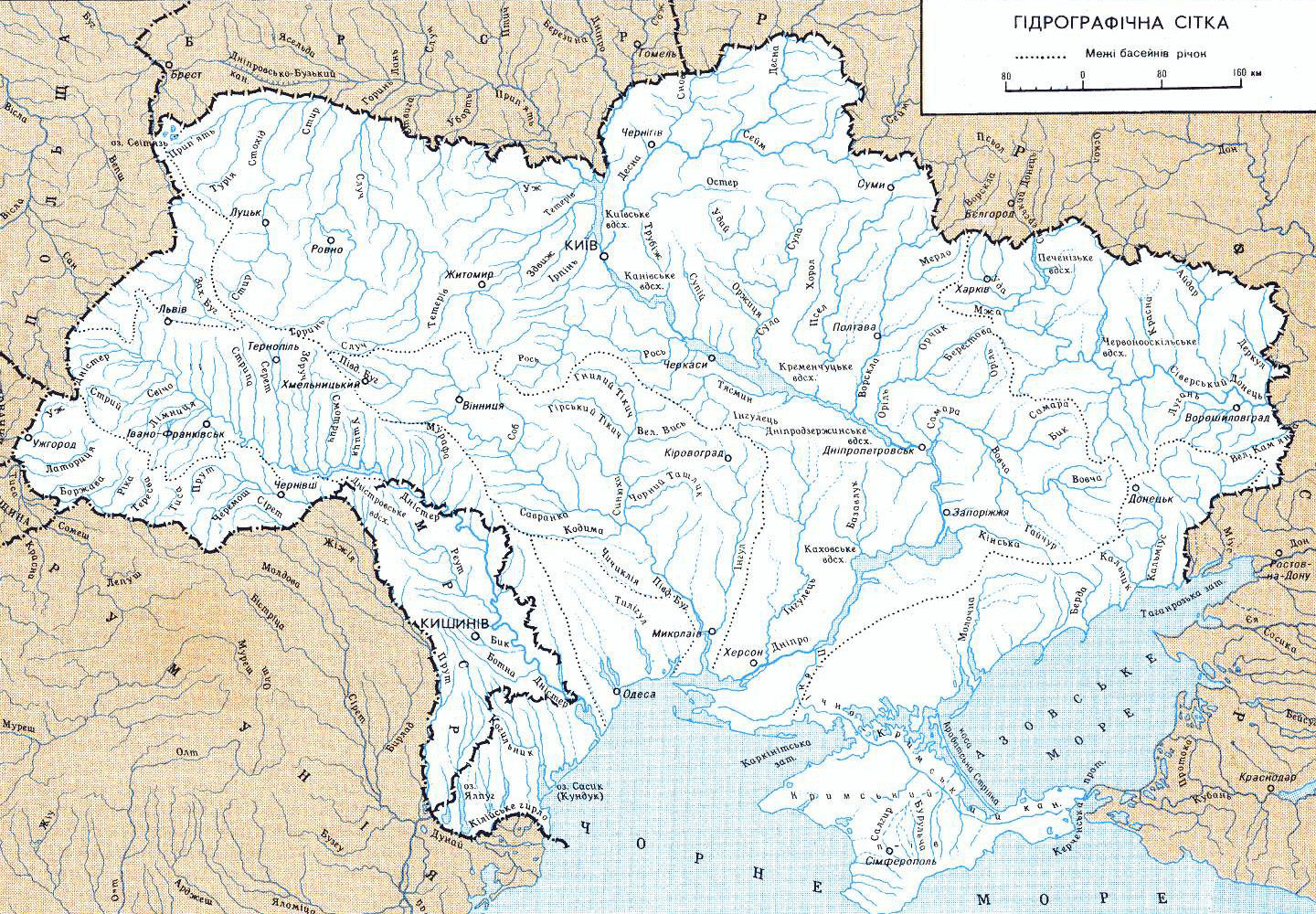
[8] Hydrographic grid of river basins of Ukraine. (n.d.). Retrieved from https://www.imbf.org/karty/images/detailed-rivers-map-of-ukraine-hq.jpg.
[9] Interactive map of river pollution in Ukraine based on data from the State Water Resources Agency of Ukraine. (n.d.). Retrieved from https://texty.org.ua/water/.
[10] Khilchevskyi, V.K. (2022). Vodni ta zbroini konflikty – klasyfikatsiini oznaky: Water and armed conflicts – classification features: In the world and in Ukraine. Hydrology, Hydrochemistry and Hydroecology, 1(63), 6-19. doi: 0.17721/2306-5680.2022.1.1.
[11] Khilchevskyi, V.K., & Hrebin, V.V. (2021). Large and small reservoirs of Ukraine: Regional and basin features of distribution. Hydrology, Hydrochemistry and Hydroecology: Bioresources and Water Ecology, 2(60), 6-17. doi: 10.17721/2306-5680.2021.2.1.
[12] Klochenko, P.D., & Shevchenko, T.F. (2019). Epiphyton as bioindicator of the state of the upper-cascade Dnipro Reservoirs. Hydrobiological Journal, 55(4), 26-37.
doi: 10.1615/HydrobJ.v55.i4.30.
[13] Klymenko, M.O., Vozniuk, N.M., & Verbetska, K.Yu. (2012). Scientific Reports of National University of Life and Environmental Sciences of Ukraine, 8(30).
Retrieved from https://nd.nubip.edu.ua/2012_1/12kmo.pdf.
[14] Kuzmenko, M.I., Hudkov, D.I., & Pankov, I.V. (2001). Radionuclides and their ecological significance in the reservoirs of Ukraine. Retrieved from http://dspace.tnpu.edu.ua/.
[15] Litvinenko, V., Kotovska, G., Buzevitch, O., & Khrystenko, D. (2021). Length-weight relationship and condition factors of white bream (Blicca bjoerkna (Linnaeus, 1758)) from the Kyiv Reservoir. Aquaculture, Aquarium, Conservation & Legislation, 14(6), 3283-3290. Retrieved from http://www.bioflux.com.ro/docs/2021.3283-3290.pdf.
[16] Lytvynenko, V.O., & Khrystenko, D.S. (2021). Peculiarities of using the Kyiv Reservoir as a fishery water object (overview). Fisheries Science in Ukraine: Bioresources and Water Ecology, 4(58), 5-28. doi: 10.15407/fsu2021.04.005.
[17] MapCruzin: Ukraine ArcGIS shapefile map layers. (n.d.). Retrieved from https://mapcruzin.com/.
[18] Mykhaylyk, O.O. (2021). The banks of the Dnipro River in Kyiv: development and transformation in time. Modern Technologies and Methods of Calculations in Construction, 16, 103-108. doi: 10.36910/6775-2410-6208-2021-6(16)-13.
[19] Nesterova, K.A., Kopilevych, V.A., & Lavryk, R.V. (2021). Assessment of the quality of water for irrigation. Riga: Baltija Publishing House.
[20] Shamanskyi, S.Y., & Boichenko, S.V. (2018). Standardization of maximum permissible discharges of biogenic elements into water bodies with wastewater in Ukraine. Environmental Sciences, №2(21), 119-126: Retrieved from http://ecoj.dea.kiev.ua/221-2018.
[21] Shcherbak, V.I. (2015). Phytoplankton succession of the Kyiv Reservoir and assessment of its transboundary section. Scientific Notes of the Ternopil National Pedagogical Institute: Biology, 3–4(64), 757-760. Retrieved from http://dspace.tnpu.edu.ua/bitstream/123456789/5946/1/Scherbak.pdf.
[22] Strokal, V. (2021). Transboundary rivers of Ukraine: Perspectives for sustainable development and clean water. Journal of Integrative Environmental Sciences, 18(1), 67-87. doi: 10.1080/1943815X.2021.1930058.
[23] Strokal, V., & Kovpak, A. (2021). Ecological assessment of water quality for different water uses: The upstream sub-basin of the Dnipro and Desna rivers. Biological systems: Theory and Innovations, 12(2), 24-40. doi: 10.31548/biologiya2021.02.003.
[24] Strokal, V., Makarenko, N., Chorna, T., & Kovpak, A. (2021). Ecological assessment of the toxicity of nitrogen compounds for aquatic organisms using the Lemna minor L. biotest. Scientific Reports of National University of Life and Environmental Sciences of Ukraine, 6(94). doi: 10.31548/dopovidi2021.06.002.
[25] Strokal, V.P., & Kovpak, A.V. (2021). Causes of nutrient pollution in the Dnieper river basin: theoretical syntheses. Environmental Sciences, 2(35), 37-44. doi: 10.32846/2306-9716/2021.eco.2-35.6.
[26] Timchenko, V.M., et al. (Ed.). (2013). Abiotic components of the Kyiv Reservoir ecosystem. Kyiv: Institute of Hydrobiology NAS of Ukraine.
[27] Voitenko, L.V., Strokal, V.P., & Myroniuk, O.O. (2018). Environmental assessment of local water resources on the example of the city of Kamianets-Podilskyi. Tavrian Scientific Herald, 1(100), 287-292. Retreived from
http://www.tnv-agro.ksauniv.ks.ua/archives/100_2018/part_1/43.pdf.
[28] Voitenko, L.V., Strokal, V.P., Myroniuk, O.O., Kochyn, K.O., & Voitenko, A.H. (2017). Methodology of comprehensive assessment of water quality for irrigation. In Materials III international scientific and practical conference of young scientists (62-78). Kyiv: Institute of Water Problems and Land Reclamation of NAAS.
[29] Volkova, E.N., Belyaev, V.V., Prishlyak, S.P., Parkhomenko, A.A., & Karapysh, V.A. (2012). Peculiarities of forming radioactive contamination of higher aquatic plants from Kyiv Reservoir. Nuclear Physics and Power Engineering, 160-165. Retrieved from https://inis.iaea.org/search/search.aspx?orig_q=RN:44117056.
[30] Yakymenko, A.N. (2013). Radiation monitoring of the surface waters of the Kyiv Region. Hydrobiological Journal, 49(6), 80-85. doi: 10.1615/HydrobJ.v49.i6.80.